Every guide ranking for this question describes a Tulum that stopped existing somewhere around 2024. None of them mentions that Tulum’s beach access was rebuilt in July 2026, that its airport is losing airlines, or that it has no marina. The word marina does not appear in any of them.
The short answer
Book Cancun if you want to swim, to fly cheaply and often, or to be on a boat without a van ride first. Book Tulum if you want cenotes, jungle, the photograph, and a slower kind of day, and you accept that getting onto open water is a 35 to 55 minute drive before anything begins.
We book charters on both sides of this coast, so the comparison below is weighted toward the thing we can actually see: where the boats are, what they cost, and what it takes to reach them. Everything has a source.
The decision in one table
| Cancun | Tulum | |
|---|---|---|
| Best for | Swimming, families, nightlife at scale, easy boat days | Cenotes, ruins, jungle, photographs, a slower pace |
| Flights | Up to 350 a day, more US flights than domestic | Two to four daily domestic expected this winter |
| Getting to a boat | Marina about 10 minutes away | Puerto Aventuras, 35 to 55 minutes north |
| The swim | Sheltered beaches on the north arm of the island | Rough at the ruins, better at the public beaches |
| The photograph | Wide, groomed, resort beaches | Wins, and it is not close |
| All-inclusive | Everywhere | Essentially nowhere |
| The daily cost trap | Priced up front | Every meal, sunbed and taxi is a separate decision |
| Sargassum | Cleared industrially before 8am | Worst hit major destination on the coast |
The cost question, and why everyone gets it half wrong
Tulum has a reputation for being more expensive than Cancun. The reputation is half true, and the half that is true is precisely the half you will be standing in.
Away from the beach road, Tulum is cheaper. Restaurant prices in Cancun run about 12.6 percent higher than Tulum’s, and groceries about 30 percent higher. An inexpensive meal is around 150 pesos in Tulum against 200 in Cancun. Beef, cheese and eggs are all materially cheaper.
On the beach road, Tulum is the most expensive strip on this coast. In late 2025 Mexico’s consumer protection agency ran an enforcement operation in Tulum and suspended more than a dozen businesses. Among the prices it found: tacos at 400 pesos and guacamole at 280. A local councillor reported coconuts at 200 pesos on the beach road. A resident put the premium simply: hotel zone prices run 50 to 60 percent above the town.
So both stories are true and they describe different streets, which is why the arguments online never resolve.
But the real driver is structural, and nobody writes it down. Cancun has large all-inclusives. Tulum essentially does not. In Cancun, food, drink and most activity cost is prepaid and capped before you land. In Tulum, every meal, every cocktail, every sunbed and every taxi is a separate variable-cost decision made at beach-road prices, several times a day, for a week.
That, rather than the room rate, is where the reputation comes from. And it is a fair one.
| Line item | Cancun | Tulum |
|---|---|---|
| Hotel zone room, per night | 150 to 400 USD at a Hotel Zone resort | 350 to 800+ USD beachfront |
| Town room, per night | From about 30 USD downtown | From about 40 USD in the pueblo |
| Short-term rental, August 2026 | 275 USD a night, up 4.5 percent on the year | 125 USD a night, down 23.6 percent on the year |
| Beach club | Usually free with a resort, or a drinks tab | 500 to 1,500 pesos per person minimum, plus 15 to 20 percent service |
| Inexpensive meal | About 200 pesos | About 150 pesos |
| Airport transfer | 30 minutes, 15 to 24 USD by taxi | 1.5 to 2 hours, 90 to 160 USD per vehicle |
| All-inclusive option | 250 to 450 USD per person per night | Essentially unavailable |
The thing that changed in 2026, and nobody in the search results noticed
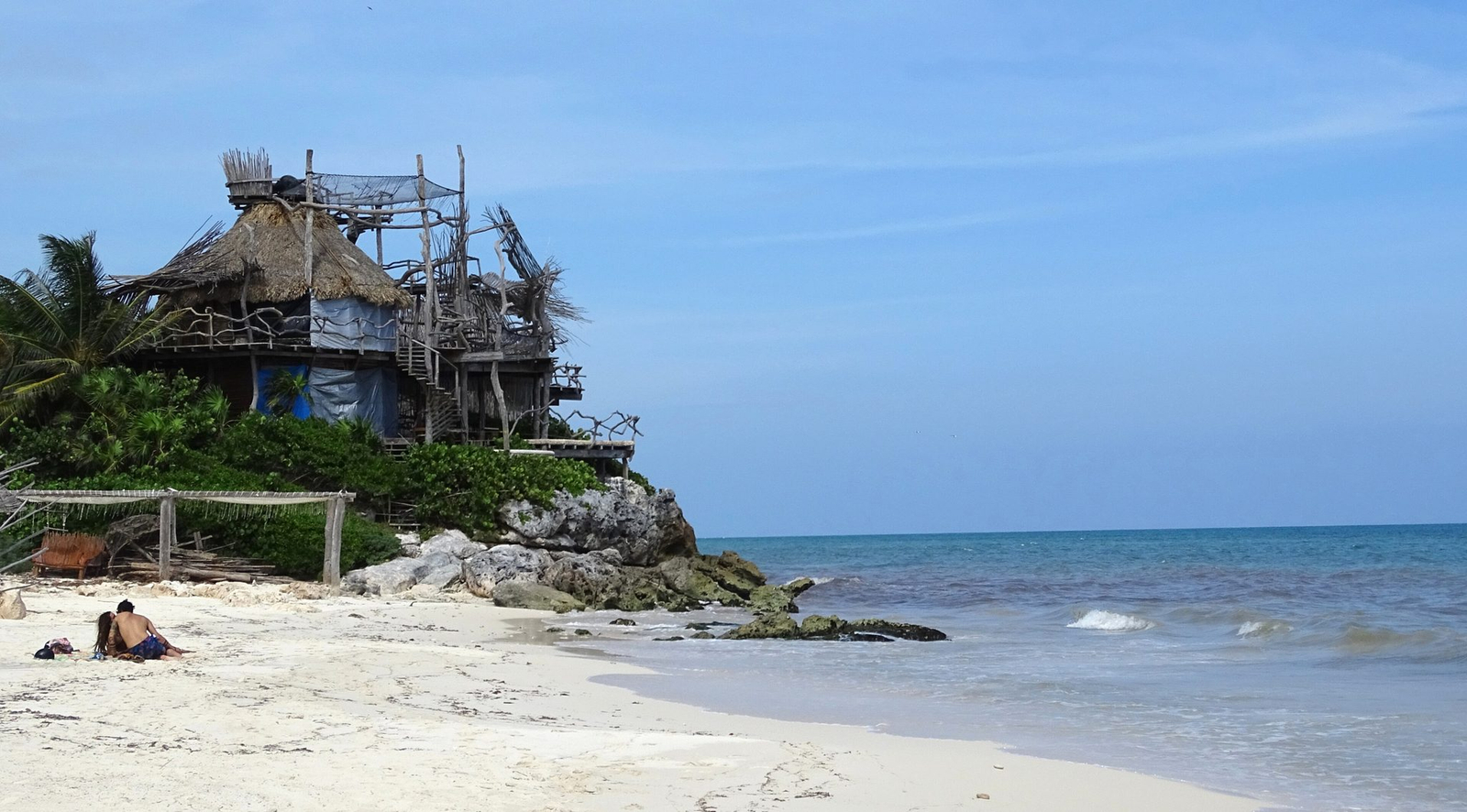
Tulum’s beach access was the centre of the backlash. In January 2025 the Army took over management of Parque del Jaguar, and entry for a family of four went from about 500 pesos to 1,400. Daily visitors to one beach and artisan area fell from 15,000 to fewer than 500, and roughly half the shops in the surrounding streets closed.
In July 2026 that was largely reversed, and every page ranking for this question still describes the old situation.
- Parque del Jaguar now contains four free public beaches: Santa Fe, Pescadores, Maya and Mangle, open roughly 6am to 6pm with free access every day.
- Two more free hotel-zone beaches at kilometre 4.5 and 5.5, with no mandatory purchase.
- Park entry is now free for all Mexican nationals, and the foreign park fee came down from 415 pesos.
- A new electric shuttle links the park, the ruins and the beaches at a flat 20 pesos a ride.
- The municipality has pledged free access at 25 public beach entry points.
Enforcement is still uneven and some private operators reportedly still charge, so do not expect it to be frictionless. But the honest 2026 position is that Tulum’s beaches got more accessible, not less, and you would not learn that from any of the top ten results.
Photographs and swimming are different questions
This is the distinction the whole category conflates, and separating it answers most people’s real question.
Tulum wins the photograph. Driftwood and thatch on a narrow sandbar, jungle behind, the ruins on the headland. That is why it became famous and the fame is deserved.
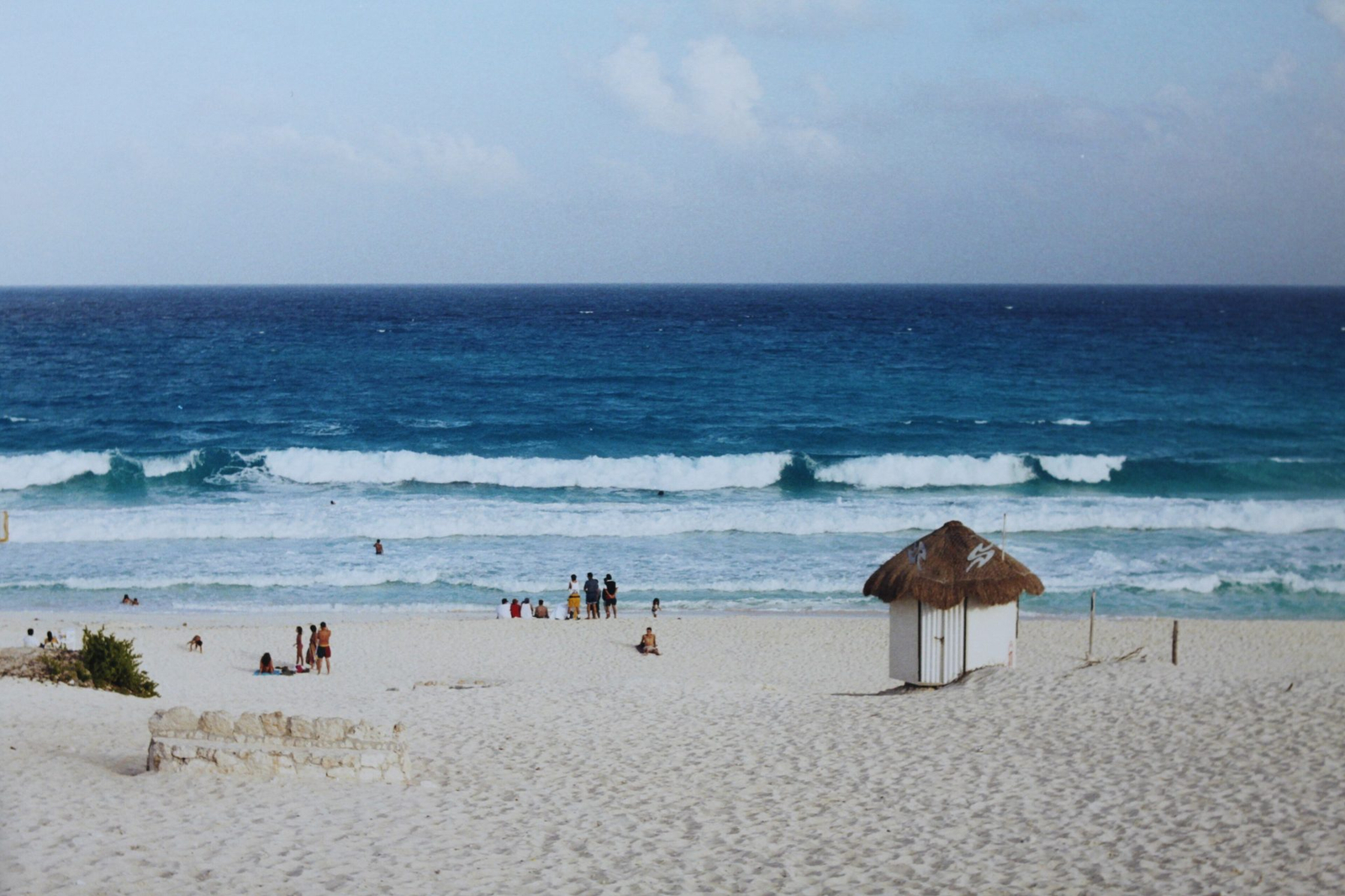
Cancun wins the swim. The Hotel Zone is a 22 kilometre barrier island shaped like a seven, and the geography does the work: the short northern arm faces into a sheltered bay with calm, shallow water at Langosta, Tortugas and Caracol, partly protected by Isla Mujeres sitting offshore. The long eastern arm faces the open Caribbean and gets the surf and the undertow.
Tulum’s beach, by contrast, is a narrow strip with one road in and out. The most honest description we found came from a tour operator who has stopped promoting the destination: “We’re talking about 4 kilometers of beachfront with just one road in and out,” and “Sometimes there’s two or three yards of it before you reach the water.” (Travel Weekly) The water at the ruins beach is frequently rough with a strong current, and it is better described as scenery than as swimming.
And the genuinely useful answer: for calm, shallow, clear water, neither of them is the best option on this coast. Playa Norte on Isla Mujeres is, along with Puerto Morelos and Xpu-Ha. All three are boat destinations, which is convenient for us to say and also true.
The boat day, which is where these two really separate
Not one of the five pages ranking for this question mentions a marina, a charter, a dock fee or where a boat physically departs from. So here it is.
In Cancun the marina is about ten minutes from your hotel, and Isla Mujeres is eight nautical miles away, a 25 to 35 minute private crossing. Shared catamaran day trips run roughly 16 to 89 USD a head. Private charters list at about 175 to 249 USD an hour for a 40 to 52 foot boat, with a four-hour minimum and a dock fee of roughly 12 to 15 USD per person on top. One honest drawback: many Cancun charters sit on the lagoon side, so the boat transits mangrove traffic before it reaches open sea.
Tulum has no marina. Charters for Tulum guests leave from Puerto Aventuras, a full-service marina 35 to 55 minutes north depending where on the beach road you are staying. The dock fee there is 20 USD per person, and the round-trip van runs 150 to 225 USD.
Which produces a number nobody in this search result has ever written down: a Tulum charter guest pays roughly 170 to 245 USD in friction before anybody steps onto a boat. That is not an argument against doing it. It is an argument for knowing it in advance, and for putting the water day in the middle of the trip rather than on the morning you fly home.
| Cancun | Tulum | |
|---|---|---|
| Marina | Several, about 10 minutes away | None. Puerto Aventuras, 35 to 55 minutes north. |
| The signature trip | Isla Mujeres, 8 nautical miles, 25 to 35 minutes | Inha Reef from Puerto Aventuras, about 45 minutes out |
| Shared day trip | 16 to 89 USD per person | About 125 USD per person for a 4 hour reef tour |
| Private charter | 175 to 249 USD an hour, 4 hour minimum | From about 900 USD, 40ft from about 1,708 |
| Dock fee | About 12 to 15 USD per person | 20 USD per person |
| Transfer to the boat | Taxi, a few dollars | 150 to 225 USD per van, round trip |
| Whale sharks, June to September | Yes, the regional centre of it | No. It is a Cancun and Isla Mujeres product. |
| Cenote diving | Possible, a drive inland | Unbeatable, and the reason to come |
The correction we owe you
We have written before that Tulum has no boats. That is too strong and we are fixing it here.
Tulum has beach-launched lanchas, and they are good value. From Playa Pescadores, just south of the ruins, boats run daily from 10am to 4pm: a shared turtle snorkel of about an hour and ten minutes for 550 pesos, a two-stop reef snorkel for 840, or a private lancha for up to eight people at 3,800 pesos. All include a pass by the ruins from the water, which is a genuinely wonderful thing to see and impossible from land.
What Tulum does not have is a protected marina, which means no yachts, no catamarans, no shade, no toilet and no bar. The accurate sentence is that Tulum has beach-launched lanchas for a one to two hour snorkel, and nothing bigger leaves from Tulum at all. If that is the day you want, you do not need Puerto Aventuras and you should not pay for it.
Tulum also owns two water experiences Cancun simply cannot offer: the lagoon float and canals at Sian Ka’an, and the boat trips down to Punta Allen. Those are genuinely exclusive to that side and they are the strongest argument in Tulum’s favour on water.
The airport problem, which changes the arithmetic
Tulum got its own international airport in December 2023, and the usual advice is that it saves you the two-hour transfer from Cancun. Check the schedule before you count on it.
Cancun runs up to 350 flights a day, with more US flights than domestic, plus South America and more than fifteen European countries. Tulum’s airport peaked at about a dozen daily international departures in January 2025. This winter it is expected to run roughly two to four daily domestic flights in total.
Aeromexico left at the end of September 2026 with nothing scheduled through August 2027. JetBlue left in March 2026. Volaris is ending its Tulum flights. United is down to Houston five times a week, American to Dallas plus a seasonal Miami, Delta to Atlanta only. Load factors tell the story: Cancun hub flights never dropped below 90 percent in peak months while most Tulum flights ran around 60.
And the saving is smaller than it sounds even when a flight exists. The airport taxi pickup from Tulum’s airport runs 60 to 100 USD, and the drive to a hotel is 40 minutes to an hour. So Tulum airport buys you roughly an hour over Cancun, not two, at a fare premium.
Which makes the real question an arithmetic one that no competing page computes: is the airfare gap bigger or smaller than the transfer gap? For two people it usually favours flying into Cancun. For four sharing one van, it favours Cancun by more.
Who should not book each one
None of the five pages ranking for this has a section like this, which is strange, because it is the useful half of a comparison.
Do not book Tulum if: you want to swim more than you want to photograph; you are travelling with small children; you are on a fixed budget and would rather not make forty separate spending decisions; you want a boat day without a van ride; your dates land between June and August, when Tulum is the worst-hit destination on this coast for sargassum; or you need reliable power for things that plug in, because most of the beach road runs on generators.
Do not book Cancun if: you came for cenotes and ruins and resent a drive to reach them; you want quiet; you dislike the resort format and would not use an all-inclusive; or you find a 22 kilometre strip of towers depressing regardless of how good the swimming is.
And consider neither if what you actually described is Isla Mujeres or Cozumel, which is more often the case than people expect.
What we see when people book
Four patterns, both sides of the coast.
People book Tulum and then discover the boat. They have a four-hour charter booked, a 45 minute drive each way they did not know about, a 20 dollar per person dock fee and a lobby pickup an hour before departure. All of it is fine when it is planned in March. None of it is fine when it surfaces on a Tuesday.
People compare the room rate and ignore the structure. Tulum’s short-term rental rates fell 23.6 percent year on year, which looks like a bargain until you add seven days of beach-road meals and taxis to it.
People use the Tulum airport without checking the schedule. It is a real airport with real flights and a dramatically thinner timetable than it had eighteen months ago. Look before you plan around it.
People book the trip they saw rather than the trip they want. Tulum photographs better than almost anywhere in Mexico. If what you actually want is to get in the water with your family for a week, the other end of the coast does that better, and we will tell you so.
Common questions
Is Cancun or Tulum better?
Cancun for swimming, families, flights and easy boat days. Tulum for cenotes, ruins and the photograph. If you want calm shallow water above all else, the honest answer is neither, and you want Isla Mujeres.
Is Tulum more expensive than Cancun?
On the beach road, considerably. In the town, Tulum is actually cheaper, with restaurant prices about 12 percent below Cancun’s and groceries about 30 percent below. The reputation comes from Cancun having all-inclusives and Tulum not, which caps one bill and leaves the other open.
Does Tulum have a marina?
No. Tulum has beach-launched lanchas from Playa Pescadores for one to two hour snorkel trips. Anything larger leaves from Puerto Aventuras, 35 to 55 minutes north, with a 20 USD per person dock fee and a van transfer of 150 to 225 USD.
Should I fly into Cancun or Tulum airport?
Usually Cancun. It runs up to 350 flights a day against two to four daily domestic flights expected from Tulum this winter, and several airlines have left Tulum during 2026. Tulum airport saves about an hour, not two, once you add its 60 to 100 USD taxi and 40 to 60 minute drive.
Can you still get to Tulum’s beaches for free?
Yes, and more easily than in 2025. Since July 2026, Parque del Jaguar has four free public beaches, two more free beaches sit at kilometre 4.5 and 5.5, park entry is free for Mexican nationals and the foreign fee was reduced. Enforcement is still uneven at some gates.
How far is Tulum from Cancun airport?
About 120 to 130 kilometres, 1.5 to 2 hours by road. A private transfer runs 90 to 160 USD per vehicle, the ADO bus is 15 to 26 USD per person to the downtown terminal, and the Tren Maya runs three departures a day reaching Tulum in about an hour and a half.
Tell us the trip, not the destination
If you describe the day you want on the water, we will tell you which end of this coast delivers it and what it costs from where you are sleeping, including the transfer, the dock fee and the hour you will actually have to leave.
Sometimes the answer is that you booked the wrong town. We would rather say that in March than let you find out on the Tuesday. If you are still choosing, the Cabo comparison and the month-by-month guide to Cancun cover the other two halves of this decision.


