Every guide to this question says the same thing: December to April, busy and expensive. Not one of them uses the numbers Quintana Roo publishes every month for free. So here is the version with the receipts, including the part where the busiest month is not the one you think.
The short answer
Late October to mid-November is the best all-round time to visit Cancun. Prices sit at the year’s floor, hurricane season is ending, the sargassum has cleared and the winter cold fronts have not organised yet. February and March have the best weather and the worst crowds and prices. September is cheapest and wettest.
We book boats out of these marinas every week of the year, which gives us a view of this question that hotel websites do not have: the months with the prettiest weather on paper are also the months the port closes most often. Every number below is sourced.
The whole year in one table
Occupancy and airport traffic come from the state government, which publishes both monthly and which no article on this subject seems to read. Rainfall is the CONAGUA station average. Cold fronts are the national weather service forecast for this season.
| Month | Hotel occupancy, 2025 | Airport passengers, 2025 | Rain | Sargassum | Cold fronts forecast |
|---|---|---|---|---|---|
| January | 80.6 percent | 2.76 million | 4.1 in | Clear, usually | 8 |
| February | 81.3 percent | 2.49 million | 2.0 in | Clear, usually | 7 |
| March | 82.5 percent, the peak | 2.94 million | 1.8 in | Season starts | 6 |
| April | 74.4 percent | 2.57 million | 1.1 in | Building | 6 |
| May | 70.4 percent | 2.34 million | 3.5 in | Significant | 2 |
| June | 73.4 percent | 2.39 million | 5.6 in | Heavy | 0 |
| July | 74.8 percent | 2.63 million | 2.7 in | Heavy | 0 |
| August | 59.4 percent | 2.32 million | 3.4 in | Heavy | 0 |
| September | 59.3 percent, the floor | 1.76 million | 7.2 in | Declining | 3 |
| October | 64.6 percent | 2.05 million | 11.1 in | Declining | 7 |
| November | 74.9 percent | 2.38 million | 5.0 in | Clear | 8 |
| December | 77.9 percent | 2.72 million | 3.5 in | Clear | 9, the peak |
Three things in that table contradict every guide you have read
The busiest month is March, not December. March ran 82.5 percent occupancy and 2.94 million airport passengers. December ran 77.9 percent and 2.72 million. Spring break beats Christmas on the full month, which is not what anybody tells you when they say Cancun is a winter destination.
August is as empty as September. 59.4 percent against 59.3. Every article treats August as peak summer and the data says it is a tie with the deadest month of the year. If your school holidays force August on you, that is better news than you expected.
October is not the bottom. It is the wettest month by a distance, 11.1 inches over 17 days, and it still runs five points busier than August and September. People turn up for the back half of it, once the rain eases, and they are right to.
And one number that puts the whole year in perspective: March moves 67 percent more airport passengers than September. Same airport, same island, 1.2 million more people walking through it.
The part nobody writes about: the port closes
If you are coming for the water, this section matters more than the weather forecast, and you will not find it in any other guide to this question.
From roughly September to May, cold fronts sweep down the Gulf and hit the Yucatan. When gusts pass about 50 to 60 kilometres an hour, the Capitania de Puerto closes the port. The rule is specific: vessels under 40 feet are barred from leaving, usually announced from seven in the morning.
How often? In 2026, the port was shut on roughly 30 of the first 100 days of the year, and the nautical sector reckoned it lost up to 30 percent of its operation. Seven separate closure events landed between 12 January and 24 February alone.
So the guides recommending January and February for calm Caribbean seas are giving boat customers advice that is wrong about a third of the time. The weather on the beach those days is glorious. The boats are tied up.
Three details that follow from this, and each one is genuinely useful:
- Ferries are exempt. On a closure day you can still get to Isla Mujeres on the Ultramar ferry while your private charter sits in the marina. That is a real fallback and nobody writes it down.
- Bigger boats sail more often. The 40-foot threshold is a hard line, so a large catamaran keeps going on days a small boat cannot. If your dates are in the front season, book the bigger vessel.
- The season has a shape. The weather service forecasts 56 cold fronts for 2026-27 against a long-run average of 50, with nine of them in December and roughly 32 between November and February. That is the window where closures cluster.
| Cold front | When the port shut in 2026 | What it meant |
|---|---|---|
| Frente Frio 27 | Monday 12 January | Cancun closed from 07:00, Isla Mujeres closed, ferries excepted |
| Frente Frio 28 | Thursday 15 January | Navigation suspended |
| Frente Frio 29 | Monday 19 and Tuesday 20 January | Two consecutive days |
| Frente Frio 30 | Tuesday 27 January | Navigation suspended |
| Frente Frio 32 | Sunday 1 February | Gusts 60 to 80 km/h, swell 3 to 4 metres. Landed on a long weekend. |
| Frente Frio 33 | Thursday 5 February | Closure from 22:00, gusts to 50 knots |
| Frente Frio 37 | Tuesday 24 February | Partial and total closures across Cozumel, Cancun, Holbox and Isla Mujeres |
Here is the reframing that is worth the whole article. In autumn, the weather risk is a tropical storm you can watch coming for five days on a forecast and plan around. In winter, the weather risk is a closure notice at seven in the morning on an otherwise beautiful day. Those are not the same kind of risk, and only one of them lets you move your booking.
We factor this in when we quote. If your dates are in the front season, we say so, and we point at the boats big enough to sail anyway.
The best window, argued with numbers
Roughly 20 October to 20 November. It is the only stretch of the year where everything lines up at once.
Rooms are at or near the annual floor, around 330 dollars a night against about 558 in December on the same aggregator, checked 5 October 2026. Occupancy is climbing off the September trough but the Thanksgiving spike has not hit. Hurricane activity is rare after the first week of November. The sargassum has cleared. And the cold fronts, while forecast at seven in October and eight in November, have not yet organised into the January and February closure cluster.
Day of the Dead and Hanal Pixan land right in it, from 30 October to 2 November, at the lowest prices of the year. Cut the window off before Thanksgiving week, when both the price and the crowd change character overnight.
The runner-up: roughly 10 to 30 April. Cold front season is finished, hurricane season has not started, and the March crowds have gone. It is the best sea state of the shoulder year. The catch is sargassum, which is usually building by then, so it depends which beach you are standing on. We covered that properly in our guide to which Cancun beaches stay clear.
The weeks to avoid, and one specific warning for 2027
15 March to 2 April 2027. Write that down.
In most years, American spring break and Mexico’s Semana Santa miss each other. In 2027 they collide. The peak US college break week starts 15 March, with 227 of 601 colleges off that week and 73 percent of all US breaks falling in the fortnight of 8 to 21 March. Mexico’s school holiday then runs 22 March to 2 April. Easter Sunday is 28 March. The Benito Juarez long weekend is 13 to 15 March. And the spring equinox at Chichen Itza, which draws ten thousand people, is 20 March.
Five separate crowd events inside nineteen days. If you have any flexibility at all, use it.
Mid-December to early January is the other one. The December monthly average of 77.9 percent hides the real story: the state finished 2025 at 85 to 90 percent occupancy, with some Isla Mujeres hotels full. Room rates peak in the same stretch, and December carries the highest forecast cold front count of the season. Beautiful time to be there. Expensive time to be there, and a risky one to book a small boat in.
| Window | What it costs you | What it buys you | Verdict for a boat day |
|---|---|---|---|
| 20 October to 20 November | A little rain early in it | Rates at the floor, hurricanes ending, sargassum gone, crowds still low | The best of the year |
| 10 to 30 April | Sargassum is usually building | No cold fronts, no hurricanes, March crowds gone | The calmest sea of the shoulder year |
| September | Wettest and peak hurricane month | Emptiest month, cheapest rooms, warmest water, whale sharks | Three forecast fronts against nine in December |
| February and March | The highest prices and crowds of the year | The best weather on land, clearest reef water | The closure season. Book a bigger boat. |
| Mid-December to early January | 85 to 90 percent occupancy and peak rates | Christmas in the Caribbean | Nine forecast cold fronts. The riskiest month for a small charter. |
| 15 March to 2 April 2027 | Everything, all at once | Nothing you cannot get in a quieter week | Avoid if you possibly can |
What is in the water, month by month
If you are coming for a specific thing rather than a general holiday, the calendar narrows fast.
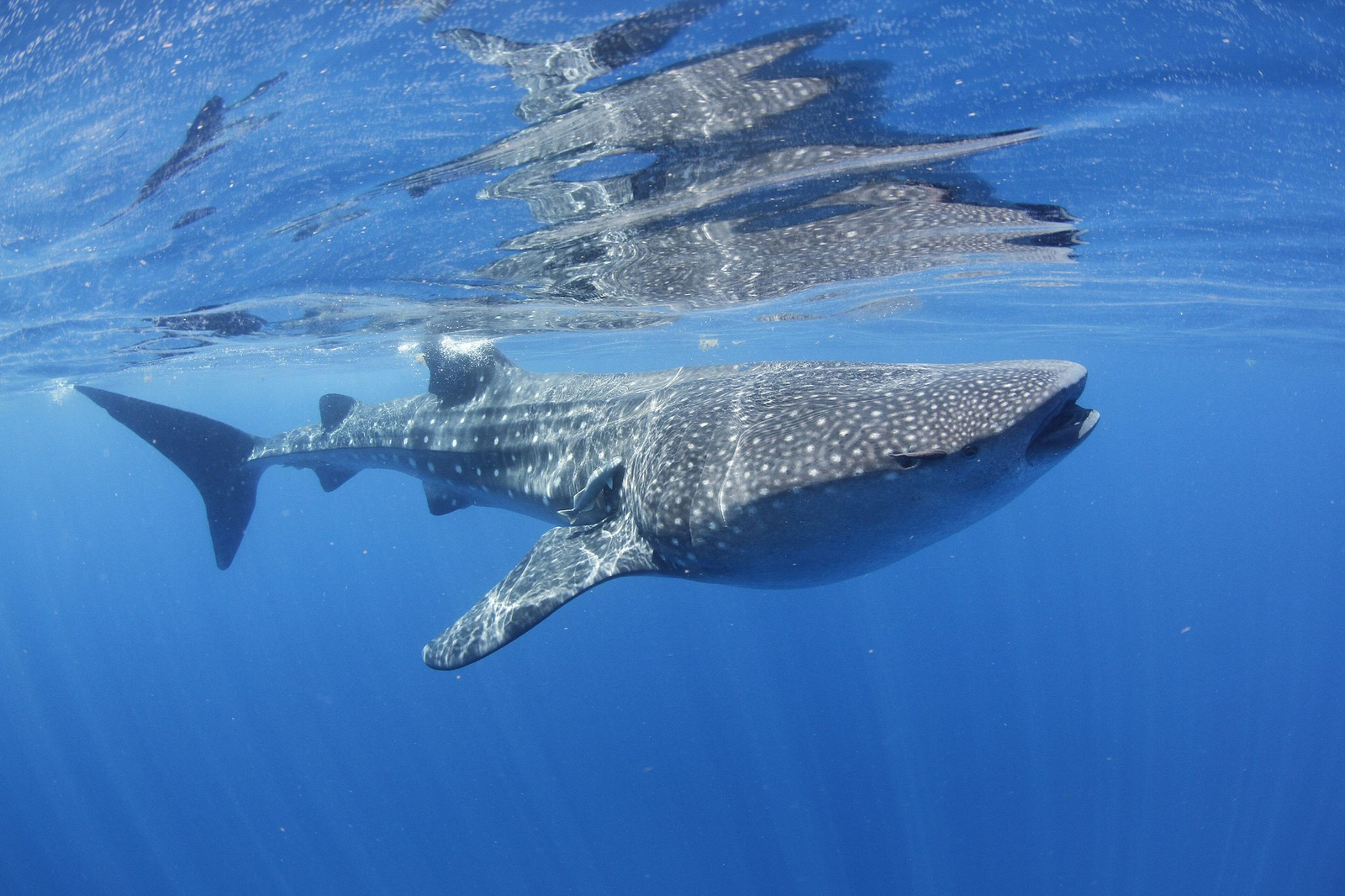
Whale sharks, roughly mid-May to mid-September. The season is set each year by CONANP inside the Tiburon Ballena biosphere reserve, and the 2026 season closed on 17 September. Peak concentration is mid-July to mid-August. Note where that sits: right in the hottest, wettest, emptiest, cheapest part of the year. The single most extraordinary thing in Cancun’s water happens in the months everyone tells you to avoid. That trip is the strongest argument for a summer booking there is.
Sailfish peak late February into early March, and the all-round fishing window is May to July when marlin, sailfish, tuna and mahi overlap. Big game slows from September through February.
Clearest water, December to April. Visibility on the reef drops through the rainy season. That part the guides get right.
Warmest water, August and September, at 86F. The coldest the Caribbean gets here is 79F in January and February, which is still warmer than most people’s idea of warm.
Prices, and the flight question nobody answers properly
Rooms are simplest: the floor is September and October at roughly 316 to 331 dollars a night, the ceiling is December at about 558 to 574, with March close behind. That is a gap of roughly 70 to 80 percent between the cheapest and dearest months, which is a lot of money for the same beach.
Flights are where the advice online falls apart, and the reason is funny once you see it. One major booking site says January is the cheapest month to fly to Cancun. Another says November, from five of the six US cities it analysed. They are both right. The first averages every US origin into one number; the second runs it city by city.
So the honest answer is that the cheapest month to fly to Cancun depends on where you live, and you should check your own airport rather than trusting a national average. No competing page says this, because saying it requires admitting the headline number is not very useful.
On how far ahead to book, three well-known sources say three weeks, six to eight weeks, and two to eight months, with the last one explicitly warning against waiting. None of them publishes the data behind it. The only safe synthesis: peak season from mid-December through April sells out, so book months ahead, while September and October have slack and reward patience.
The honest case for September and October
These are the months everyone warns you about, so here is both sides with actual figures.
What you give up. October is the wettest month of the year, 11.1 inches over 17 days. September is the statistical peak of the Atlantic hurricane season, which NOAA dates from 1 June to 30 November with a 10 September high point. And low season is when resorts shut wings for renovation, which nobody mentions in the brochure.
What you get. The emptiest water of the year, with Isla Mujeres down at 46.2 percent occupancy in September. Rooms 40 to 45 percent below the December peak. The warmest sea of the year. Day of the Dead at the lowest prices of the year. And, for anyone chartering a boat, three forecast cold fronts in September against nine in December, which means a far lower chance of waking up to a closed port.
The hurricane number, straight. Long-run records put Cancun’s odds of a direct hurricane hit at roughly once every seven years, and a major hurricane about once every twenty-two. The last widely agreed direct hit was Wilma in October 2005. Because the season runs six months, the chance of one landing on your specific week is small, and we are not going to pretend to calculate it for you.
The 2026 season is the best illustration of the difference between a risk window and a forecast. Six named storms, zero hurricanes, a satellite-era record, and no impact on Quintana Roo at all. A whole hurricane season with no hurricanes in it.
What we see when people book
Four patterns, and the first one costs people the most.
People book the boat for January because the weather looks perfect. It usually is, on land. Then a front comes through, the port shuts at seven in the morning, and a small charter does not sail. Nobody told them this was a thing, because nobody writes it down.
People avoid August and September on reputation. Those two months are a statistical tie for the emptiest of the year, they are the warmest water, they are the cheapest rooms, and the whale sharks are there. The rain is real. So is everything else.
People assume hotel occupancy tells them how busy the water is. It no longer does. Air traffic fell 6.3 percent in the first seven months of 2026 while cruise passengers rose 12.6 percent. Fewer hotel guests, many more day-trippers, and they concentrate on Isla Mujeres and Cozumel on cruise-call days. Book the early departure.
People plan around the equinox date and get the worst of it. The serpent shadow at Chichen Itza is visible for roughly ten days around 20 March, not only on the day itself. Go on the 17th and see the same thing with a fraction of the ten thousand people.
Common questions
What is the best month to visit Cancun?
November, for the balance. Weather is dry, prices are near the floor, hurricane season is ending and the sargassum has cleared. February and March have the best weather outright but the highest crowds and prices of the year.
What is the cheapest time to go to Cancun?
September and October. Rooms run roughly 40 to 45 percent below the December peak, and September is the emptiest month of the year at 59.3 percent hotel occupancy against 82.5 percent in March.
What is the worst time to visit Cancun?
Mid-March, for crowds and prices. In 2027 specifically, avoid 15 March to 2 April, when the peak US spring break week, Mexico’s school holiday, Semana Santa and the Chichen Itza equinox all stack inside nineteen days.
When is hurricane season in Cancun?
1 June to 30 November, peaking around 10 September. Direct hits are rare, roughly once every seven years, and the last widely agreed one was Wilma in October 2005. The 2026 season produced six named storms and no hurricanes at all.
When is the water calmest for boat trips?
Late April through early November. Cold fronts close the port to vessels under 40 feet from roughly November to March, and in 2026 that meant around 30 closure days in the first 100 days of the year.
When can you swim with whale sharks?
Roughly mid-May to mid-September, with the exact dates set each year by CONANP. The 2026 season closed on 17 September, and peak concentration is mid-July to mid-August.
Pick the week, then let us pick the boat
Send us the dates you are considering, even if they are not settled. We will tell you what the water is likely to be doing that week, whether your dates fall in the closure season, and which boats sail anyway if they do.
And if your week turns out to be a bad one for Cancun, we will say so. We book the other coast too.


