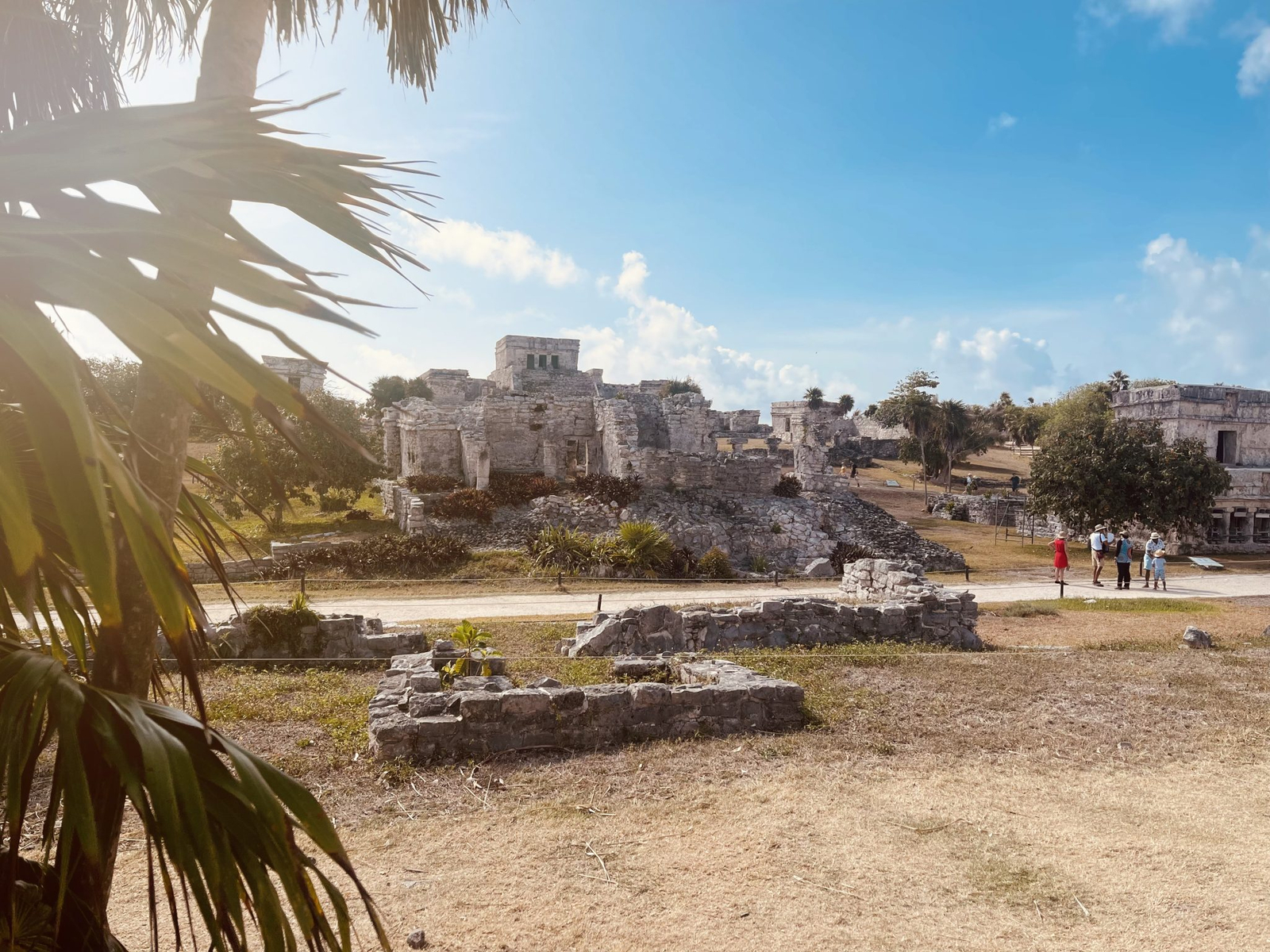
Tulum sells you three things: a beach club, a cenote and a yacht day. Two of them are in Tulum. The third leaves from a marina 40 minutes up the coast, and most groups find that out when the van turns up at a quarter to nine.
The short answer
A bachelorette party in Tulum works best across three or four nights: beach clubs on the hotel strip, one cenote morning, dinner in the jungle and a day on the water. Plan the boat first, because Tulum has no marina. Charters leave from Puerto Aventuras, 35 to 55 minutes north, and the transfer is rarely included in the price.
We book the boats along this coast, so we are the ones who get the late message asking why a Tulum yacht day has a pickup point in Akumal. None of what follows is a secret. It is just missing from every itinerary we have ever been sent.
Tulum is one of the three destinations in our guide to a bachelorette party in Mexico, and it is comfortably the one with the most moving parts.
What a Tulum bachelorette actually costs, line by line
Here is the part the itineraries skip. These are published prices, not estimates, and the column on the right is the one that shows up after everybody has already said yes.
| What | Published price | The bit nobody mentions |
|---|---|---|
| Beach club day bed at Taboo | 2,500 MXN per person, about 150 USD | Half comes back as food and drink credit. Last arrival is 2pm. |
| Private day bed for six at Bagatelle | 20,000 MXN, about 1,185 USD | Adults only, paid in full within 48 hours, 15 percent gratuity on top |
| Cenote entry at Gran Cenote | About 25 USD per person | The life jacket is free and mandatory. Your sunscreen is neither. |
| Private catamaran, four hours, up to ten | About 1,400 USD from Puerto Aventuras | A 20 USD per person dock fee and a 10 percent service fee sit outside that |
| Van to the marina and back | 150 to 220 USD for up to twelve | Pickup runs 60 to 75 minutes before the boat leaves |
| Taxi, beach road to Tulum town | 350 to 600 pesos and up | No meters, no rideshare apps, and no negotiating once the door shuts |
| Visitax, the Quintana Roo visitor tax | 293 pesos, about 18 USD each | Pay it online before you fly and skip the airport queue |
Where does the Tulum boat actually leave from?
Puerto Aventuras, 35 to 55 minutes north of the hotel zone depending how far down the beach road you are staying. Smaller speedboats often run out of Akumal instead, about 25 minutes north. Neither of them is Tulum.
This is not us being pedantic. One Riviera Maya operator says it in writing: Tulum has no real marina, and “all Tulum-based charters depart from Marina Puerto Aventuras, guests make their own way there, no transfer included.” Another is blunter: there is no dock we can pick up or drop off at anywhere along that stretch of coast.
The same operator explains why they will not just sail down and collect you. Sailing to Tulum and back adds six hours on top of the actual trip, against a 35 to 55 minute drive. So the boat stays where the boat lives and you do the moving. Boats are stubborn that way.
Three numbers follow from that, and none of them appear in a quote:
| Departure point | Drive from the Tulum hotel zone | What runs from there |
|---|---|---|
| Marina Puerto Aventuras | 35 to 55 minutes north | Catamarans, yachts, snorkel trips and sunset sails |
| Akumal | About 25 minutes north | Smaller speedboats and private charters |
| Muyil, in Sian Ka’an | About 30 minutes south | The lagoon float. No yachts, no bar, no sound system. |
| Tulum itself | You are already there | Nothing. There is no marina and no charter dock. |
- The dock fee. 20 USD a head, collected at the pier, usually in cash, plus a mandatory 10 percent service and maintenance charge on the charter itself.
- The van. 150 to 220 USD round trip for up to twelve people, which is perfectly reasonable right up until you realise nobody budgeted for it.
- The clock. Pickup is 60 to 75 minutes before departure. A 10am boat is an 8:45am lobby call, which is a noticeably different holiday from the one everyone agreed to.
There is one boat genuinely inside Tulum’s own municipality and it is worth knowing about: the Muyil lagoon float in the Sian Ka’an Biosphere Reserve. You ride across two lagoons, then drift down a canal the Maya cut by hand. About 1,000 pesos to do it yourself, or 170 to 229 USD a head on an organised tour with pickup. It is a boat. It is not that kind of boat, and nobody is drinking anything on it.
If you want the yacht day, the honest way to plan it is to treat the Playa del Carmen and Puerto Aventuras stretch as your departure coast and Tulum as where you sleep. We cover all of it, including what really runs out of Tulum.
How much does a Tulum bachelorette party cost per person?
For three to four nights, flights excluded, the published bands run roughly 600 to 900 USD for the budget version, 900 to 1,400 for the one most groups actually book, and 1,400 to 2,500 and up once villas and private boats join the conversation. Those come from one of the most detailed itineraries published and they match what we see.
The gap between the band and the final bill is almost always the same four things: the Visitax, the dock fee, the card surcharge and taxis. Which brings us to the taxis, because in Tulum everybody eventually gets to the taxis.
The beach clubs, and what they really charge
Tulum beach clubs do not have a cover charge so much as a minimum spend in a nicer outfit. Here is what the main ones publish.
Taboo charges 2,500 pesos a head for a beach bed, about 150 USD, and hands 1,250 of it back as food and drink credit. Private sections work the same way at 50 percent: a cabana for six runs 15,000 to 20,000 pesos, and the presidential deck for twelve to fifteen is 85,000 to 92,500 pesos, or roughly 5,000 USD. A 15 percent gratuity goes on automatically. Groups of eight or more get 4 USD a head off the round-trip transport, which is the smallest discount in hospitality and we admire the confidence.
The detail that catches people out: the latest arrival is 2pm, even though the place stays open until seven. Turn up at three and you have bought a very expensive look at the door.
Bagatelle is adults only, 18 and over, with a beach chair at 2,000 pesos a person and a cabana for twelve at 60,000 pesos, about 3,550 USD. Private sections are prepaid within 48 hours. Its listing has carried a temporary closure notice, so confirm it is open on your dates before anyone gets emotionally attached.
Vagalume runs a beach club until six and a night club until one, Thursday to Sunday. Reported minimums land around 1,500 pesos per lounger and 4,000 to 10,000 for a table, and the published figures do not fully agree with each other, so ask them directly and get the answer in writing.
Rosa Negra takes tables from 2,000 pesos. The show peaks around 8:30 to 9pm, and dinner at 6:30 is a genuinely different restaurant: quieter, and one where a conversation survives. Papaya Playa Project runs its full moon party on the Saturday closest to the full moon rather than on the full moon, which is how a group planning around a lunar calendar arrives exactly one day late. Tickets usually 2,200 to 3,000 pesos.
Cenotes, and the rule that ruins the hair
Direct answer first: no sunscreen, no makeup, no repellent, no lotion. Not the reef-safe kind at some cenotes and not the biodegradable kind at most. You shower before you swim, and it is a rule rather than a suggestion.
Gran Cenote will send you back to the showers if you arrive wearing chemical sunscreen. Entry is about 25 USD, it opens at 8am and it sits eight minutes from Tulum town on the Coba road. The life jacket is free and mandatory. Dos Ojos is 350 pesos to snorkel. Casa Tortuga is around 500 pesos and gives you four cenotes with a guide.
The reason for the ban is better than the usual environmental hand-wave. Biodegradable describes what eventually happens to a substance, not what happens on contact, and breaking it down needs microbes, oxygen and light. A cenote is dim, enclosed groundwater with very little of any of the three. Whatever goes in essentially stays in.
So the running order matters. An hour of hair and makeup followed by a compulsory public shower is a sequencing problem, not a bad day. Cenote first, photos after.
Getting around, and the taxi thing everyone warns you about
They are right to warn you. Tulum taxis have no meters, the local union has kept the ride-share apps out, and that combination does exactly what you would expect it to.
A three-day study of Tulum fares found the cheapest ride recorded was 350 pesos for a 1.5 kilometre, five-minute trip, and 86 percent of passengers interviewed had paid over 500. Beach road to town gets quoted at 600 and up. Drivers rarely negotiate, because there is another fare thirty seconds up the road and everybody knows it.
What works instead: bikes at 150 to 200 pesos a day, colectivos at 20 to 80 pesos, and booking your transfers ahead so the only vehicle you argue about is none of them. On the boat day that is already handled, because the van is part of the charter.
When to go, and the seaweed nobody puts in the brochure
November to April, and December through April is the reliable stretch: clear skies, low humidity, warm water and, above all, the clean beach season.
Sargassum season runs April to October and peaks June through August. Tulum is the worst-hit major destination on this coast, because the beach faces south into open water with no reef shelf in front of it and no room for the heavy machinery that clears it elsewhere. The University of South Florida forecast 2026 as a likely record year, which is a forecast rather than a result, but it started early enough in January to take seriously.
Hurricane season is June to November, with September and October wettest. Rain in those months is usually a violent 90 minutes in the afternoon rather than a washout, which sounds fine until it lands on the one day you booked the boat.
Here is the useful part. A boat day is the sargassum workaround. The seaweed piles up on the shore, not two miles offshore, and the coves you reach by water are often clean on a morning when the beach outside your hotel is not.
Where to stay, and the hair dryer problem
Three areas, and they are genuinely not interchangeable.
The beach road is the Tulum from the photographs, and most of it is not connected to the town’s electrical grid. It runs on diesel generators, to the tune of around nine million litres of fuel a year across the strip. Plenty of properties ask guests not to use hair dryers or curling irons. Eight people, one bathroom, no hair dryer, and a dinner reservation. Ask before you book, not after.
Aldea Zama is the practical one: paved roads, reliable power, real internet, five minutes to town and five to the beach. Villas for ten to twenty sit here and they are usually newer and cheaper than beachfront. Tulum Pueblo is the cheapest of the three and the most cash-dependent.
One more thing worth knowing while you negotiate. Tulum hotel occupancy fell from 66.7 percent to 49.2 percent year on year in September, according to the state tourism ministry, and coastal rates have moved with it. A destination in that mood answers emails.
What we see when people book
Four things come up over and over, and all four are avoidable.
The yacht day booked without a departure point. Somebody books a private charter “in Tulum” off a listing and only discovers at the confirmation stage that the boat is 45 minutes away with a separate transfer. It is fixable. It is a great deal more fixable in March than the night before.
The boat on departure day. A four-hour charter, a 45 minute drive each way, and a flight out of Cancun that wants three hours plus a two-hour transfer. The arithmetic does not close. Put the water day in the middle of the trip where it belongs.
The 8am cenote after the 2am club. Gran Cenote at opening is genuinely magical and nearly empty. It is also seven hours after Vagalume shuts. Pick one, or split the group and stop pretending everybody wants the same morning.
The card-only group. Dock fees, colectivos, tips, market stalls and most small kitchens are cash. Card surcharges of 3 to 5 percent are normal at beach clubs. And when the card terminal offers to charge you in dollars, say pesos, because that convenience runs 3 to 7 percent over the real rate and has been measured above ten.
Common questions
Does Tulum have a marina?
No. Tulum has no full-service marina and no dock for charter pickups or drop-offs. Boats for Tulum guests leave from Puerto Aventuras, roughly 35 to 55 minutes north, or from Akumal, about 25 minutes north, for smaller speedboats.
How far ahead should we book the boat?
Seven to ten days is usually enough in normal season. For spring break, Christmas and New Year, allow three to four weeks. The larger catamarans that take a whole bachelorette group are always the first thing to go.
How many nights do we need in Tulum?
Three nights is tight but workable. Four is the sweet spot: an arrival day, a cenote morning, a boat day and a beach club day, with the nights arranged around them.
Is Tulum expensive for a bachelorette party?
Yes, by Mexican standards, and more than most people expect. Budget 600 to 900 USD per person for three or four nights at the low end, and 900 to 1,400 for the version most groups actually book, before flights.
What is the best month for a Tulum bachelorette party?
December through April. Dry, clear, and outside the sargassum season that runs April to October and peaks in June, July and August.
Do we need cash in Tulum?
Yes. Bring pesos for dock fees, taxis, colectivos, tips and small restaurants. Cards work at hotels, beach clubs and larger restaurants, often with a 3 to 5 percent surcharge.
Planning the water day?
Tell us your dates, how many of you there are and which side of Tulum you are sleeping on. We come back with the boats that actually fit, the marina they leave from, and the transfer time built into the plan instead of discovered at 8:45am.
You bring the group. We will make sure the group and the boat end up in the same place.


