Nobody tells you the useful version of this. Cabo’s whale season is set by one federal agency, Cancun’s whale shark season by another, and the two windows do not overlap by a single day. So the honest answer to Cabo or Cancun usually starts with a question about your calendar.
The short answer
Go to Cancun if you want to swim off the beach, warm water all year and cheaper flights from the eastern half of the United States. Go to Cabo if you want desert scenery, almost no rain, no seaweed and a boat ride that starts five minutes from the dock. If you are flexible on dates, the wildlife calendar should decide it.
We book boats in both, which is a slightly unusual position to write this from: we have no reason to talk you into either one, and every reason to get you to the right one. Everything below is sourced, and where the sources disagree we say so.
The decision in one table
| Cabo San Lucas | Cancun | |
|---|---|---|
| The landscape | Desert meeting the sea, mountains behind the town | Flat limestone jungle, white sand, turquoise shelf |
| Swimming off the beach | A handful of safe bays. Most of the coast is not swimmable. | Most of the hotel zone, with a sheltered side and an exposed side |
| Rain, per year | 10 inches over 14 rainy days | 51 inches over 112 rainy days |
| Sea temperature | 72F in March, 85F in September | 79F in January, 86F in August |
| Sargassum | None. Not less, none, in any month. | March to October, heaviest June to August |
| Flights | Short from the US west, long from the east | Short from the east, and cheaper from everywhere |
| The boat day | Land’s End is a five minute ride | Isla Mujeres is an eight mile crossing |
| In the water | Humpback whales, 15 December to 30 April | Whale sharks, roughly mid-May to mid-September |
The calendar is the real answer
This is the part no comparison article runs, and it is the part that actually decides the trip.
Cabo’s whale watching season is not a rule of thumb. It is published each year by SEMARNAT in the Diario Oficial de la Federacion, and the notice for the 2025-26 season gives Cabo San Lucas as 15 December to 30 April. Worth knowing: almost every operator advertises 15 April. The federal notice says 30 April. The same document also draws a two kilometre no-go zone around the Arch during the season, which is why your whale trip runs out past it rather than around it.
Cancun’s whale shark season is set the same way by CONANP inside the Tiburon Ballena biosphere reserve, and it runs roughly mid-May to mid-September. The 2026 season closed on 17 September and was the best in years, with peak counts of 200 to 400 animals in the water between Isla Contoy and Isla Mujeres.
Put those two next to each other and the whole question changes shape.
| Month | Cabo San Lucas | Cancun | The catch |
|---|---|---|---|
| December to February | Whales. Peak season. Driest, coolest nights. | Clearest water of the year, no seaweed | Cabo’s sea is at its coldest, 71 to 73F |
| March to April | Whales until 30 April. Still bone dry. | Sargassum season begins | Mid-March is spring break in Cancun |
| May | Between seasons. Zero rain on average. | Whale sharks open. Sargassum building. | The one gap where neither destination has its headline animal |
| June to August | Hot, humid by Cabo standards. Marlin running. | Whale sharks at their peak, mid-July to mid-August | Cancun’s heaviest sargassum months |
| September to October | Wettest months, and the hurricane peak on that coast | Season winding down, rain arriving | October in Cancun is 11 inches of rain over 17 days |
| November | Drying out, water still warm at 81F | Sargassum clearing, weather turning good | Neither has its wildlife season running |
The line that falls out of it: the two destinations are at their best for in-water wildlife in opposite halves of the year, and neither is at its best in October or November. If your dates are fixed, that table has probably just chosen for you.
The thing the resort websites do not tell you about Cabo
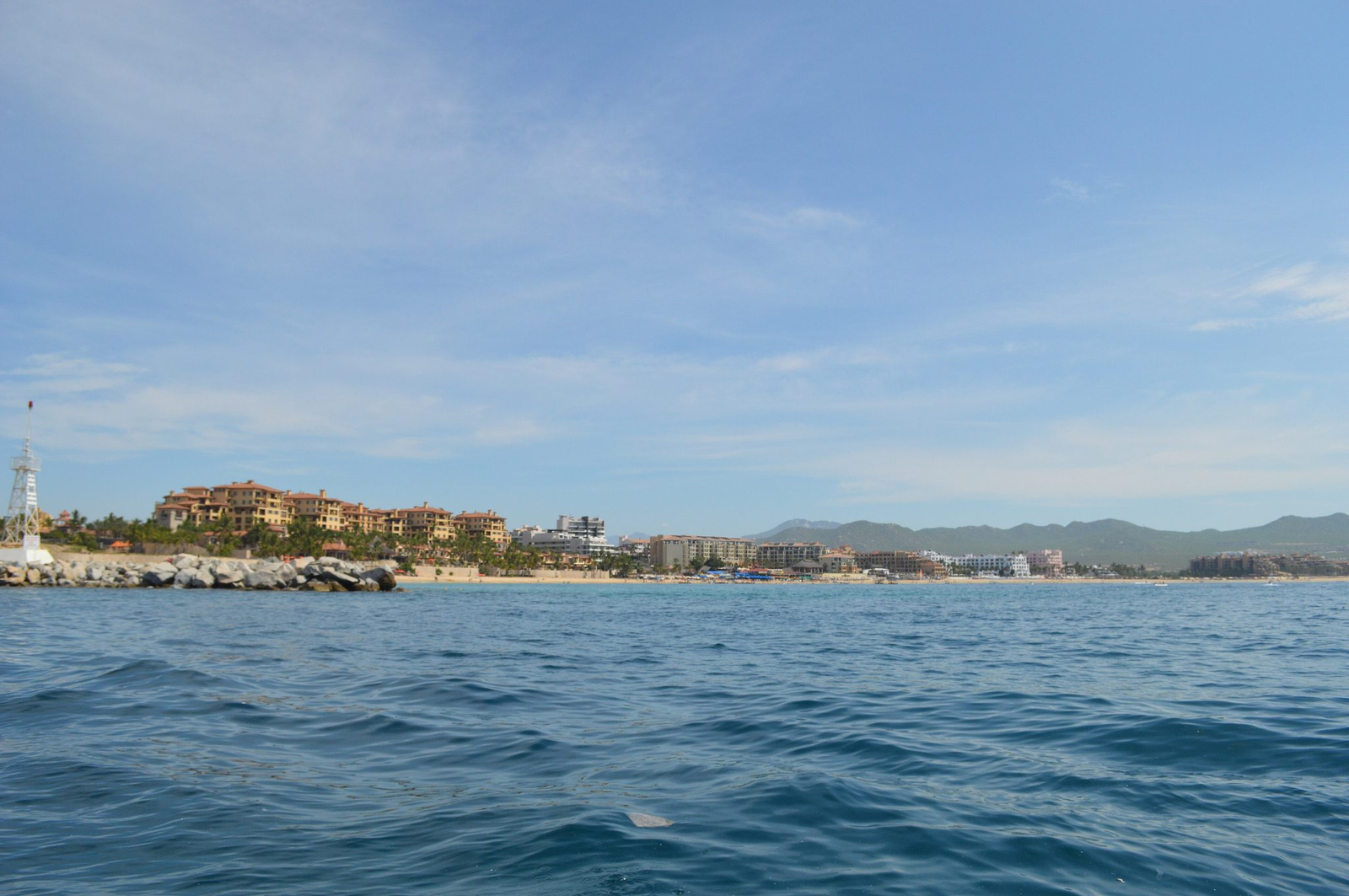
You cannot swim off most of Cabo’s beaches, and people find this out on arrival.
Search any travel forum and you will find the same thread posted over and over, usually by somebody already there: I booked a beachfront resort, how do I get in the ocean. One reply sums up the whole problem better than we could: “Just discovered through another post that a lot of the beaches there aren’t swimmable, which of course the resort websites don’t tell you.”
The accurate version is not “you cannot swim in Cabo”. It is that there are roughly five or six reliably swimmable beaches across the whole twenty-mile corridor, they are all on the Sea of Cortez side, and the sand in front of your hotel is probably not one of them. The official tourism board names Medano, Lovers Beach, Playa Acapulquito, Chileno and Cabo Pulmo as safe, and otherwise tells you to look for the green flag.
Two beaches get named as genuinely dangerous rather than merely rough: Divorce Beach, where entering the water is prohibited and the Navy has pulled tourists out of the surf, and Playa Solmar, with the same steep drop-offs. The flags are run by the federal maritime authority and they mean what they say: green safe, yellow caution, red high danger, black closed, white dangerous marine life.
Here is the part that is both true and convenient for us, so treat it with appropriate suspicion and then check it: in Cabo, the boat is how you get in the water. Lovers Beach, Pelican Rock, Santa Maria and Chileno are all calm, and two of them are easiest to reach from the sea. A half day on the water in Cabo is not a luxury add-on the way it is elsewhere. It is the swimming.
And the thing nobody tells you about Cancun
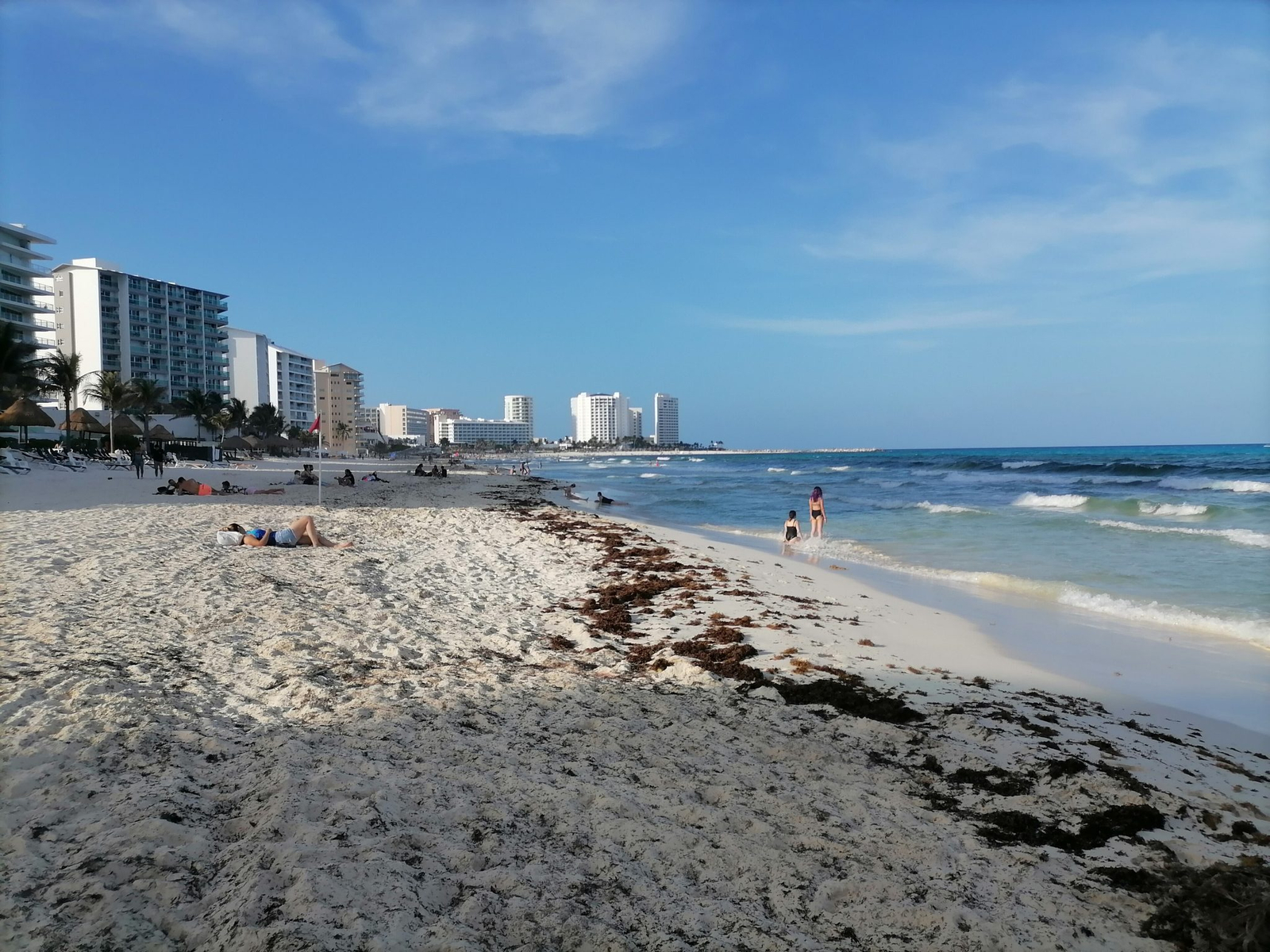
Cancun’s equivalent problem is seaweed, and it has a calendar rather than a coastline.
Sargassum runs roughly March to October and is heaviest June through August. It is a Caribbean system, which is why the beach you booked can be buried in July and spotless in January. Cancun’s hotel zone is shaped like a seven: the short northern arm faces into a sheltered bay and stays reasonably clear, and the long eastern arm takes the current head on.
We wrote a whole guide to which Cancun beaches stay clear because the popular advice on this is genuinely wrong, including guides that recommend the most exposed beaches in the hotel zone as the clear ones.
Cabo, by contrast, gets none. Not less. None. Sargassum is an Atlantic phenomenon and there is no current that carries it into the Pacific or the Sea of Cortez. The cleanest evidence is not a travel article, it is the monitoring: the University of South Florida’s Sargassum Watch System covers the Caribbean, the Gulf and the tropical Atlantic and does not track Mexico’s Pacific coast at all, and Mexico runs a state monitoring network in Quintana Roo and none in Baja California Sur. Governments do not fund monitoring for problems that do not exist.
The boat day, which is a different product in each
This is where the two destinations diverge most and where every comparison article stops short.
In Cabo, the headline sights are about five to ten minutes from the marina. El Arco, Lovers Beach, Pelican Rock, the sea lion colony and Neptune’s Finger sit inside a circuit of roughly eight to ten nautical miles round trip, comfortably done in an hour or two. In Cancun, the classic day is the crossing to Isla Mujeres: eight nautical miles each way, fifteen to thirty minutes of open water, before the sightseeing even starts.
That single difference explains the pricing, and once you see it you cannot unsee it.
| Cabo San Lucas | Cancun and Isla Mujeres | |
|---|---|---|
| Listings start around | 190 USD an hour | 135 USD an hour |
| Typical minimum | 3 hours | 4 to 5 hours |
| Why the minimum | The sights are minutes from the dock | There is a crossing before anything happens |
| Boats listed | Roughly 325 | Roughly 700 |
| The standard route | The Arch, Lovers Beach, Pelican Rock, the sea lions | Playa Norte, the Manchones reef, the underwater museum |
| What cancels it | El Norte winds, late October to late April, and port closures for swell | Winter cold fronts. Frentes frios 27 to 32 all closed ports in early 2026. |
| Marinas | Fewer and larger, built for big boats and sportfishing | More numerous and smaller, built around day-tour volume |
So Cabo is effectively priced by the hour and Cancun by the day, and comparing the headline hourly rates will mislead you. Compare the total for the trip you actually want. We broke the whole thing down in what it costs to rent a yacht in Mexico, destination by destination.
One more thing that belongs in an honest comparison: both destinations cancel boat trips regularly, in different months, for different reasons, and in both cases the smaller boats get grounded first. Cabo loses days to wind and swell from late October into April. Cancun loses them to winter cold fronts. Anyone who tells you their coast is always calm is selling.
Flights, and the coast rule
The rule is simple and sharper than most people expect. Los Angeles to Cabo is about two and a half hours. Los Angeles to Cancun is about four and three quarters. Miami to Cancun is under two hours. New York to Cabo is about six and a half.
The surprise is the fares. Round trips priced in late September 2026 came out lower to Cancun from every city tested, including Los Angeles, which cuts straight against the assumption that the nearer airport is the cheaper one. Cancun moves roughly four times the passengers Cabo does, is served from more than forty US cities, and that volume shows up in the price.
Practical read: west of the Rockies, Cabo is a genuinely shorter trip and worth the fare. East of the Mississippi, Cancun wins on both counts and it is not close.
What it actually costs
The cliche is that Cabo is expensive and Cancun is cheap. The truth is more specific and more useful.
Day-to-day spending is close to a wash. Two independent budget trackers put Cabo around 169 USD a day per person against Cancun around 163, and a separate itemised 2026 comparison lands at 141 against 136. Those are the same number wearing different hats.
The real gap is the floor, not the average. The Los Cabos Hotel Association projects the destination closing 2026 above 500 USD a night, and all-inclusive prices there rose 15 percent in 2026. Cancun has genuine budget all-inclusives that simply do not exist in Los Cabos. So Cabo is more expensive at the top of the market and roughly level in the middle.
Food is the one line where the gap is real: eating out in Cabo runs noticeably higher, with dinner roughly 40 USD a head against 15 to 25 in Cancun. And the airport transfer is a clean, checkable difference: the run from Cabo’s airport costs roughly two to three times Cancun’s and takes about twice as long, because it is thirty miles rather than twelve.
The small print that catches people
Four differences that never make a comparison article and each cost somebody money last year.
The clocks. Mexico abolished daylight saving in 2022. Baja California Sur sits on Mountain Standard all year, so Cabo reads the same as US Pacific in summer and US Mountain in winter. Quintana Roo sits on UTC-5 all year, which means Cancun is one hour behind US Eastern during the US summer and level with it in winter. That is a genuinely common booking error.
The tourist taxes, and the age rules are opposite. Baja California Sur charges 488 pesos, about 28 USD, for foreign visitors over 12 staying more than 24 hours. Quintana Roo’s Visitax is roughly 283 pesos, about 15 USD, and exempts nobody, infants included. For a family of four with two small children, those work out very differently. Quintana Roo also layers an environmental sanitation charge and a 3 percent lodging tax onto the hotel bill, so a Cancun traveller can see three separate charges where a Cabo traveller sees one.
Uber works in both, and cannot collect you at either airport. In Cabo that is a bureaucratic restriction: no federal concession to pick up at the terminal, though dropping off on the way out is fine. In Cancun it is an actual conflict, with a taxi union of around twelve thousand members, road blockades in 2023 and a US Embassy security alert attached to it. The app at Cancun airport mostly dispatches an authorised airport taxi at taxi prices rather than a normal Uber. Arrive on a booked transfer in both places and the problem disappears.
Mandatory tips are illegal, and Cancun restaurants kept adding them. Mexico’s consumer protection agency issued a warning in early 2026 about hotel zone restaurants auto-adding 15 percent service to bills. Check the bill before you tip on top of it. And tip in pesos rather than dollars: staff exchanging dollar tips lose a fifth to a third of the value at the counter, so the generous-feeling dollar note is worth less than the peso equivalent.
What we see when people book
Four patterns, and the first one is the whole article.
People pick the destination, then discover the season. They book Cabo in July because the flights were cheap and then read about whale watching. They book Cancun in January and find the whale sharks are four months away. Both mistakes are free to avoid and neither is recoverable afterwards.
People book beachfront in Cabo expecting to swim. Then the flag is red for the third day running. If swimming off the sand is the point of the holiday, that points at Cancun, or at a Cabo hotel on Medano rather than on the Pacific corridor.
People compare the hourly boat rates. Cabo looks expensive, Cancun looks cheap, and then the Cancun minimum is five hours because of the crossing. The totals land much closer together than the headline rates suggest.
People assume one of them must be objectively better. Having read a great many forum threads for this article, we can report that the people who have been to both are split almost exactly down the middle, often in the same thread, often with equal confidence. It is not that kind of question.
Common questions
Is Cabo or Cancun better?
Neither, consistently. Cancun is better for swimming off the beach, warm water year round and cheaper flights. Cabo is better for dry weather, desert scenery, no sargassum and a boat trip that starts minutes from the dock. If your dates are fixed, the wildlife calendar is the tiebreaker.
Can you swim in the ocean in Cabo San Lucas?
On some beaches. Medano, Lovers Beach, Chileno, Santa Maria and Palmilla are the reliable ones, all on the Sea of Cortez side. Much of the Pacific-facing corridor has steep drop-offs and strong undertow and is regularly red-flagged. Check the flag before you go in.
Does Cabo get sargassum?
No. Sargassum is an Atlantic system and no current carries it into the Pacific or the Sea of Cortez. Cabo San Lucas, San Jose del Cabo, La Paz and Puerto Vallarta are unaffected in every month of the year.
Which is cheaper, Cabo or Cancun?
Cancun, mainly at the bottom of the market: it has budget all-inclusives that Los Cabos does not, and flights are cheaper from most US cities. Day-to-day spending is close to level, though eating out in Cabo runs noticeably higher.
When can you see whales in Cabo?
The 2025-26 federal season runs 15 December to 30 April, with January and February the heaviest concentration. Most operators advertise a 15 April finish, two weeks earlier than the published notice.
When can you swim with whale sharks in Cancun?
Roughly mid-May to mid-September, with exact dates set each year by CONANP. The 2026 season closed on 17 September. Peak concentration is mid-July to mid-August, and boats are capped at ten passengers.
Still deciding?
Tell us your dates and what the day on the water is supposed to feel like. We book both coasts, so we will tell you which one your week actually suits, including when the answer is the destination you were not considering.
Then we will send the boats that fit, from the Cabo fleet or the Cancun one, whichever won.


